My Perspective on Sustainable Healthcare Leadership
I have always noticed that a sustainable healthcare institution is much more complicated than simply growing the infrastructure or raising the number of patients as a healthcare professional. The essence of real sustainability is to come up with systems that are scalable, which meet the changing regulations, which are financially sound and highly dedicated to providing high standards of patient care. In the course of time, I have learned to observe that sustainable healthcare platforms were not created by chance; instead, they are the results of well-planned leadership, data-driven governance, and a culture of constant improvement.
In the current dynamic healthcare setting, leaders should not focus only on short-term returns but rather focus on the long-term institutional strength. Healthcare management sustainability deals with developing organizations that can adapt to policy changes, technological changes, workforce changes and changing patient expectations, without affecting quality or profitability.
Defining Sustainable Healthcare Institutions
Sustainable healthcare organizations are organizations that can maintain efficiency in operations, maintain compliance with its regulatory framework, financial stability and clinical excellence in the long-term. They are purposely crafted to deflect and be able to adjust to external shocks, such as economic volatility, societal health crises, and changing policy environments. Global systems advocated by the World Health Organization support the need to have resilient health systems that can be depended upon to deliver quality care. In India, there are regulatory and accreditation requirements made under the National Accreditation Board of Hospitals and Healthcare Providers which further streamline the sustainability agenda underpinning quality benchmarks and patient safety measures.
This means that the concept of sustainability in healthcare administration is multidimensional in itself; it combines all components of governance, regulatory compliance, digital transformation, strategic infrastructure planning, and human resource development to create a single, coherent approach to healthcare management.
Strategic Leadership as the Foundation
There is no denying the fact that no healthcare institution can ever become sustainable without strong and transformative leadership. Strategic leaders also focus the institutional interests on the long-term growth strategies instead of short-term operational targets, which involves a critical assessment of risks, market trends, and the financial planning should effectively promote clinical objectives. Strategic healthcare leadership represents a strict procedure of making predictions on the demand of the services, developing specialty units according to the epidemiological indicators, and maximizing the utilization of resources. The leaders that have a profound knowledge of healthcare economics can strike a balance between cost-containment and quality improvement to achieve profitability without injuring patient outcomes.
Sustainability goes beyond expansion, it is a disciplined growth that is supported by governance systems, performance measures and accountability systems.
Scalability in Healthcare Platforms
Scalability refers to the ability of a healthcare institution to expand the services, increase patient throughput, and expand the scope of operation without impacting the quality and efficiency. Standard operating procedures and digital systems integration are the requirements as well as robust infrastructure is needed to develop scalable healthcare platforms.
Hospitals investing in electronic medical records, centralized procurement systems, and data analytics tools are in a better position to duplicate the processes in different departments and satellite units. Examples like the Mayo Clinic demonstrate how a well-organised governance and integration of technology can help to maintain the provision of the same services within various institutions.
In addition, the concept of workforce planning is essential in scalability. Formal training, management training and standardized clinical protocols all help to protect against a thinning of service quality as the organization grows. Strategic leadership ensures that the expansion remains in line with the operational capacity and financial viability.
Regulatory Compliance and Governance
Compliance is one of the pillars of sustainable healthcare management. As a matter of fact, healthcare organizations must be involved in strict regulatory frameworks that include patient safety, infection control, biomedical waste disposal, clinical documentation, and human-resource standards.
Continued congruence with the requirements of accreditation organizations and legal requirements works to avoid institutional risk and also enhance credibility. Governance and structures that involve internal audit, quality-improvement committees, and systematic reviews of policies are also very helpful in increasing compliance readiness levels. The conceptualization of sustainable healthcare platforms must be based on a system where compliance is not a response, but an operational principle of the system. Foregrounding regulatory awareness by leaders leads them to build institutions that enjoy resiliency when subjected to legal examination and accountability.
Financial Sustainability and Profitability
Compliance is one of the pillars of sustainable healthcare management. As a matter of fact, healthcare organizations must be involved in strict regulatory frameworks that include patient safety, infection control, biomedical waste disposal, clinical documentation, and human-resource standards.
Continued congruence with the requirements of accreditation organizations and legal requirements works to avoid institutional risk and also enhance credibility. Governance and structures that involve internal audit, quality-improvement committees, and systematic reviews of policies are also very helpful in increasing compliance readiness levels. The conceptualization of sustainable healthcare platforms must be based on a system where compliance is not a response, but an operational principle of the system. Foregrounding regulatory awareness by leaders leads them to build institutions that enjoy resiliency when subjected to legal examination and accountability.
Digital Transformation and Operational Efficiency
Digital transformation is one of the leading pillars of the construction of sustainable healthcare facilities. These technologies improve operational effectiveness, reduce the number of clinical errors, and create a stronger type of patient interaction through the switching of analog to electronic health records and the use of predictive analytics, as is demonstrated in modern longitudinal research.
The integrated hospital information systems help to track the continuous clinical outcomes, real-time inventory maintenance, and financial performance indicators. The concomitant automation is relieving the administration burdens, as well as, reducing turn-around times, which has been supported by various cohort analyses. In addition, the introduction of complex data analytics provides leaders with the ability to identify systemic inefficiencies and take remedial interventions in a proactive manner.
The digital maturity also provides organizations with the scalability through enforcing homogenous working processes in disparate departments. Technological institutions that look forward build platforms that have the natural adaptability to accommodate future changes as well as maintaining structural consistency, therefore, both stability and responsiveness in a constantly changing healthcare environment.
Workforce Development and Organizational Culture
Human capital is one of the crucial components of healthcare system sustainability; qualified clinicians, strictly trained nursing staff, effective administrative cadres and highly motivated support staff are all the ingredients of institutional efficacy. Strategic leadership committees appropriately appreciate the fact that a direct impact is created by the investment in workforce development on the quality-of-service delivery and stability of operations, hence the reciprocal relationship that exists between the enhancement of human capital and organizational stability.
Continuous training programmes, leader development programs and systematic performance appraisal systems all act as drivers of professional growth and can be used to promote the culture of lifelong learning amongst the practitioners. In this kind of environment, a culture that is instilled with a high sense of accountability and cooperative practice would result in long-term employee retention, which is consistent with the expressed concepts of modern human resource theory and research findings.
Sustainable institutions encourage interdisciplinary communication and, at the same time, recognize personal and group achievements; such activities strengthen the spirit and develop greater involvement. Leadership builds teams that are ready to deal with the complex and changing nature of healthcare provision by creating a framework where scholarly study and career growth are valued.
The educational enrichment and professional development-oriented leadership creates flexible, strong units that are competent in addressing the intricacies of the healthcare setting in the current era, thus establishing a framework of continuous excellence and systems-wide innovation.
Patient-Centered Care and Quality Assurance
Sustainability of healthcare institutions in the long term is directly connected with the development of patient trust. The organizations, which value patient safety, strictly observe ethical principles, and have open communication with one another, always develop strong images in competitive markets.
The use of quality assurance mechanisms such as systematic clinical auditing, careful evaluation of patient feedback and strict tracking of outcomes will make sure that the improvement is continuous. As patient experience is put at the center of operational strategy, the institutions will be characterized by increased loyalty and increased credibility in the community.
Sustainable healthcare platforms understand that profitability and patient-centered care are not the only exclusive goals. Instead, regular providing of high quality does not only boost brand image, but also patient volumes, which strengthens financial performance.
Environmental and Social Responsibility
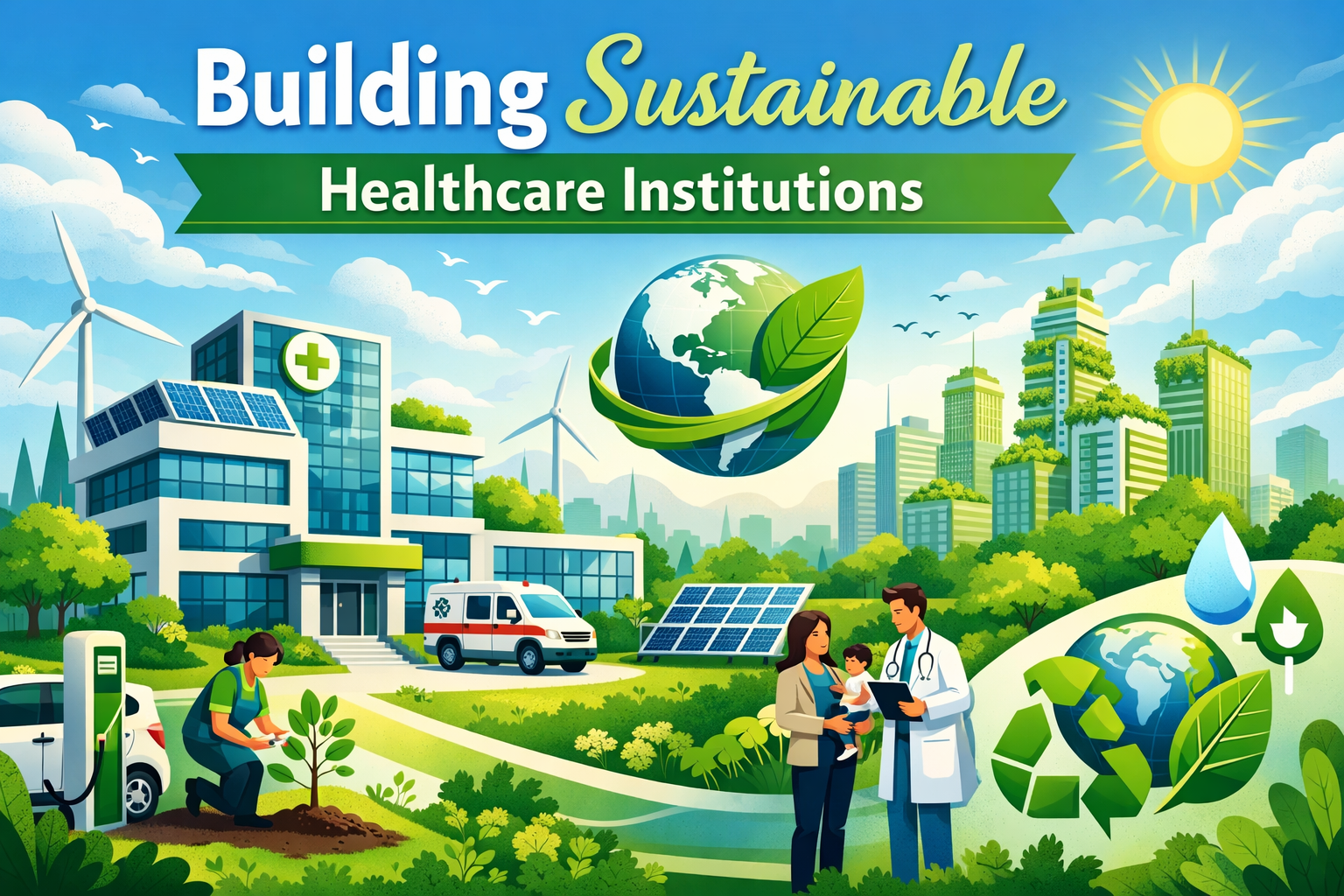
Sustainability in modern healthcare also encompasses issues of environmental stewardship and community engagement. Green infrastructure, waste management, and environmentally responsible procurement practices help ensure long-term operational costs savings and environmental sustainability.
Community outreach, health promotion, and public awareness efforts further underscore the importance of relevance. Sustainable healthcare leadership understands that social value adds to the long-term viability of institutions.
Risk Management and Crisis Preparedness
Healthcare organizations should be ready for uncertainties like public health crises, disruptions in the supply chain, and financial instabilities. Risk management tools, emergency preparedness strategies, and contingency budgeting help.
Scenario planning and reserve capacity by leaders will make them more prepared to safeguard the continuity of operations. Sustainability requires readiness, flexibility, and proactive leadership.
Conclusion: Strategic Leadership as the Catalyst for Sustainability
Building sustainable healthcare institutions requires more than infrastructure expansion or short-term financial success. It demands strategic leadership capable of integrating scalability, regulatory compliance, operational efficiency, workforce development, and patient-centered excellence into a cohesive framework.
Sustainable healthcare management is about creating platforms that endure. It involves disciplined governance, data-driven decision-making, digital integration, and financial prudence. Leaders who adopt a long-term vision ensure that their institutions not only survive but thrive in competitive and evolving healthcare landscapes.
Ultimately, creating scalable, compliant, and profitable healthcare platforms is not a single initiative. It is a continuous strategic journey led by informed, adaptive, and visionary leadership committed to excellence at every level.